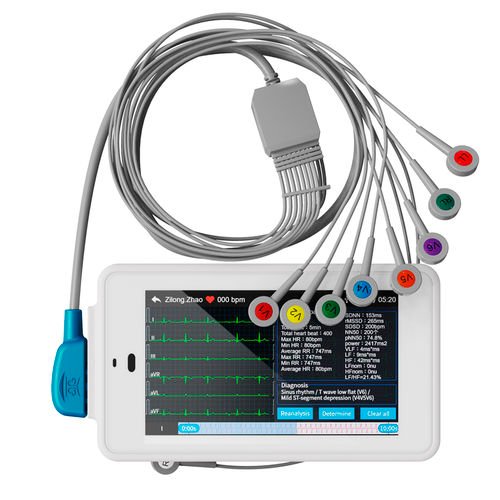
For decades, getting a reliable read on your heart rhythm meant a cumbersome Holter monitor, a tangle of wires, and a strict appointment schedule. That era is over. Today’s portable ECG monitors are compact, clinically accurate, and powerful enough to catch arrhythmias that standard exams miss. I have spent my career evaluating these devices, and I can tell you the gap between consumer-grade and medical-grade is narrower than ever. The real challenge is choosing the right one for your specific physiology and lifestyle.
THE THREE PILLARS OF A WORTHWHILE DEVICE
When I evaluate a portable ECG, I look at three non-negotiable features. First, LEAD CONFIGURATION. A single-lead device (using two fingers or a thumb) is excellent for detecting atrial fibrillation and basic rate issues. But if you experience dizziness, palpitations, or syncope, you need a multi-lead device that captures a more complete electrical picture, often using a chest electrode or a six-lead layout. Second, ALGORITHM VALIDATION. The onboard AI must be cleared by regulatory bodies, not just marketed as "smart." A good algorithm will distinguish between atrial fibrillation, premature ventricular contractions, and sinus rhythm with over 95% sensitivity. Third, DATA ACCESS. The device is only as good as what your cardiologist can read. Look for PDF or CSV export of raw waveforms, not just a colored summary. A doctor needs to see the P-wave and the QRS complex, not a traffic light.
THE COMPARISON THAT MATTERS
Let me break down the current landscape into three practical categories. For the everyday user who wants spot checks, the KARDIA MOBILE is still the gold standard for single-lead simplicity. It is small, fits in a pocket, and its finger placement is foolproof. However, it requires a smartphone for display, which can be a barrier for older patients. For a more continuous picture, the APPLE WATCH SERIES 9 and the SAMSUNG GALAXY WATCH 6 both offer on-demand ECGs and irregular rhythm notifications. Their strength is passive monitoring, but their weakness is the same: they record for only 30 seconds at a time and are prone to motion artifacts. For the clinician or the serious patient, the ALIVECOR KARDIA MOBILE 6L is my top pick. It captures six leads by using a chest patch and two finger electrodes, giving you a vector view that can identify ischemia and axis deviations. The trade-off is price and a slightly longer setup time. The ZIO XT, while technically a patch, deserves mention because it provides up to 14 days of continuous data without any user interaction, making it ideal for elusive, infrequent symptoms.
WHAT TO LOOK FOR IN YOUR SPECIFIC CASE
Before you buy, ask yourself one question: what am I trying to catch? If you have post-meal palpitations that last a minute, a single-lead device is sufficient. If you wake up with a racing heart and feel faint, you need a six-lead unit. Also, consider BATTERY LIFE and SENSOR MATERIAL. Nickel allergies are common, and many electrodes cause contact dermatitis. Choose a device with a medical-grade stainless steel or a hypoallergenic coating. Finally, check the APP ECOSYSTEM. Does it allow you to annotate symptoms in real time? Can you share a PDF directly with your doctor via email or a patient portal? If you have to print a report and fax it, you are in the wrong decade.
THE FINAL WORD
My recommendation is simple. Start with a six-lead device if your budget allows, because it gives your physician the most diagnostic power. If cost is a factor, the single-lead Kardia remains a solid, proven choice. Do not be seduced by fancy smartphone integration alone. The best portable ECG is the one you will actually carry, use correctly, and that produces a trace your doctor can trust. Invest in that, and you have bought more than a gadget; you have bought peace of mind.
Medical Devices
The Quiet Revolution in Cardiac Monitoring