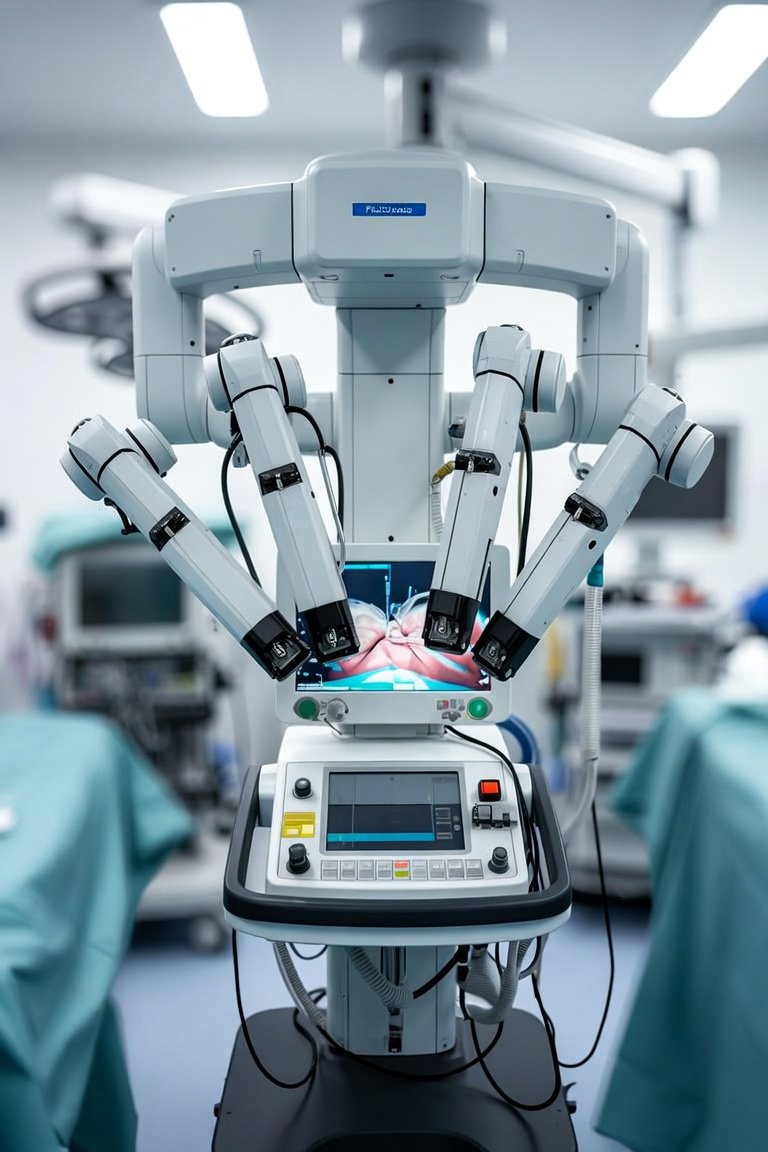
Walk into any modern operating room and you will see the familiar sights: the sterile field, the scrub nurse, the anesthesiologist at their station. But increasingly, you will also see a high-resolution monitor displaying real-time anatomical overlays, tissue perfusion maps, and predictive warnings that were not there a decade ago. Artificial intelligence is no longer a research curiosity. It is a clinical tool that is quietly changing how we plan, execute, and evaluate surgery. For the practicing surgeon, the question is no longer whether to engage with AI, but how to do so safely and effectively.
The first thing to understand is what AI-assisted surgery actually does today. It is not autonomous robotics. It is decision support. The core features fall into three practical categories. First, image guidance: AI algorithms process preoperative CT or MRI data to create three-dimensional reconstructions that highlight vascular structures, tumor margins, and critical nerves. During a laparoscopic or robotic procedure, these models are registered to the live video feed, giving you a real-time map that compensates for tissue shift. Second, tissue characterization: using optical coherence tomography or hyperspectral imaging, AI can differentiate healthy tissue from pathology with a sensitivity that often exceeds the human eye. This is particularly valuable in oncologic resections where margin status is everything. Third, intraoperative safety monitoring: AI tracks instrument position relative to vital structures and alerts you when you are approaching a danger zone, much like a modern car's lane departure warning.
When comparing systems, you need to know the difference between embedded and standalone platforms. Embedded AI comes integrated into robotic surgical systems like the da Vinci with its Firefly fluorescence and SureForm stapling analytics. These are turnkey solutions, but they lock you into a specific ecosystem. Standalone platforms, such as the ones from companies like Stryker or Brainlab, offer AI modules that work with your existing laparoscopic towers or navigation systems. They are more flexible but require careful calibration and data integration. A third option is cloud-based analytics, where intraoperative video is processed remotely to provide predictive insights. The latency is acceptable for non-critical alerts, but I would not rely on it for real-time vascular avoidance. For most hospitals, the practical sweet spot is a hybrid approach: embedded AI for the primary procedure and a standalone module for complex cases like liver resections or skull base surgery.
What should you look for when evaluating AI tools? Start with validation data. Ask for the specific sensitivity and specificity numbers for the tissue classification algorithm, not just the marketing brochure. Check that the system was trained on a diverse patient population, not just one center's data. Then, consider workflow integration. The best AI is invisible. If the system requires you to stop and click through menus, it will fail in the heat of surgery. Look for systems that automatically register images and provide alerts on a secondary screen without disrupting your field of view. Finally, think about the learning curve. Plan for at least five to ten supervised cases before you trust the AI's recommendations implicitly. And always remember: the AI is a consultant, not the attending. You have the final call.
The evidence is compelling. Studies show that AI-assisted navigation reduces positive surgical margins in prostatectomy by up to 20 percent and decreases blood loss in hepatic resections by an average of 150 milliliters. But the true value is in the subtle moments: when the system flags a vessel you were about to clip, or when it shows a margin that you would have missed. My recommendation is to start small. Pick one procedure you do frequently, choose a single AI module that addresses a specific pain point, and run a three-month pilot. Track your outcomes and your team's comfort level. The technology is ready. The question is whether we are ready to embrace it with open eyes and steady hands.
Innovations & Tech
The Operating Room Has a New Teammate: What Surgeons Must Understand About AI Assistance